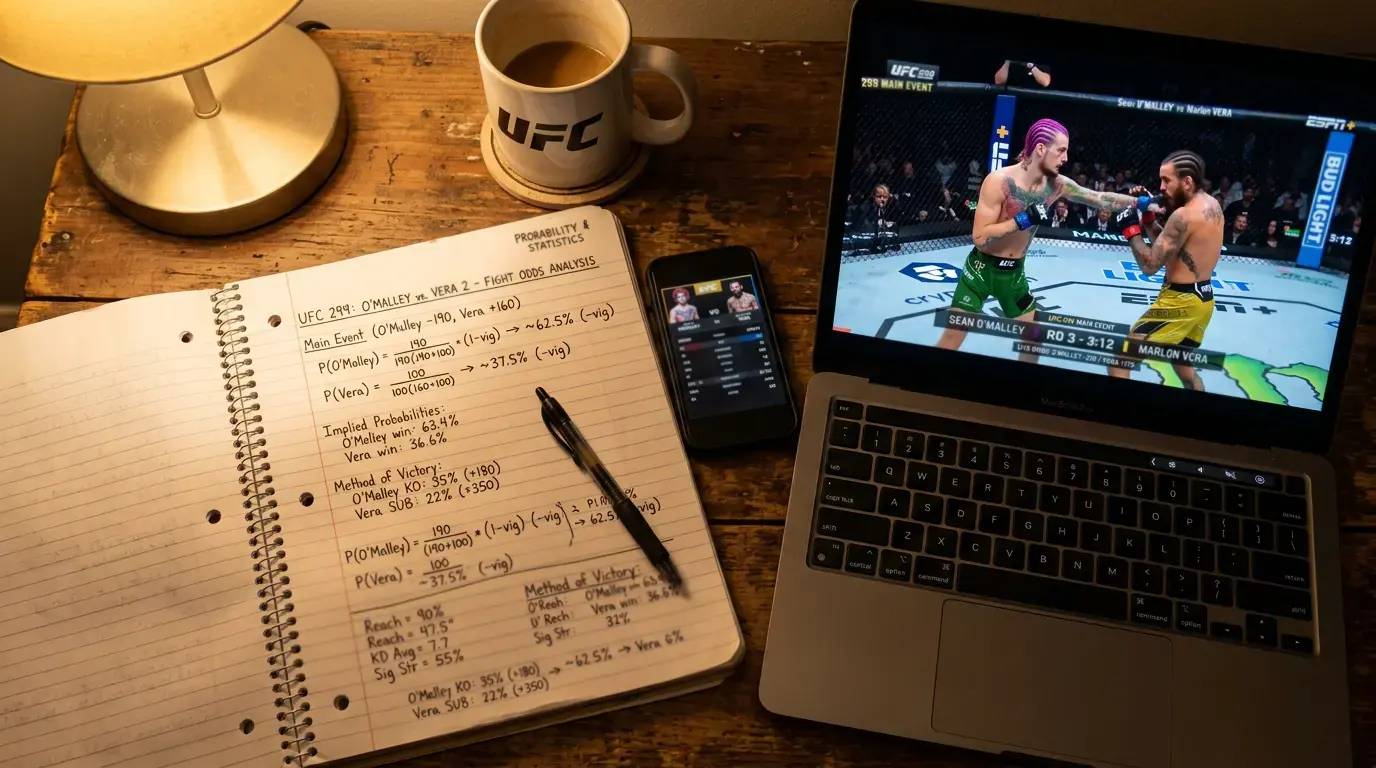
Fractional and Decimal Formats: UFC Betting Odds
 Available in US
I spent my first year betting on UFC fights without properly understanding the numbers staring back at me from the screen. I’d see a fighter listed at 4/1 and think “right, decent payout” without grasping what that number was actually telling me about the fight. The MMA betting handle hit $10.3 billion in 2024 – a 17% jump from the previous year – and a significant chunk of that money came from punters who read odds the way I used to: superficially.
That changed when I started treating odds not as decoration on a betting slip, but as a language. Every format – fractional, decimal, American – is saying the same thing in a different accent. Once you learn to translate fluently between them, you stop guessing and start calculating. You begin to see where bookmakers have priced a fighter too cheaply or too expensively, and that’s where the real edge lives.
This guide walks you through each odds format you’ll encounter when betting on UFC in the UK, shows you how to convert between them without a calculator (though I’ll forgive you for using one), and – most importantly – teaches you how to extract the implied probability hidden inside every price. By the end, you’ll read odds the way a corner reads body language: instinctively, and with purpose.
Fractional UFC Odds: The UK Wagering Standard
Walk into any betting shop in Manchester or pull up a UKGC-licensed app, and fractional odds are what you’ll see first. They’ve been the native language of British betting since long before anyone threw a leg kick in an octagon, and they remain the default for UK punters wagering on UFC. Winnings from those bets are entirely tax-free in the UK – the operator pays the duty, not you – which makes understanding what fractional prices actually promise all the more worthwhile.
The format is simple: two numbers separated by a slash. The number on the left tells you how much profit you’ll make for every unit represented by the number on the right. At 4/1, you pocket four pounds of profit for every one pound staked. At 2/5, you earn two pounds for every five risked. Your original stake always comes back on top.
Where it gets interesting in MMA is how those fractions map to the realities of fighting. A heavyweight bout between a knockout artist and a wrestler might see the striker priced at 1/3 (strong favourite) and the wrestler at 5/2 (clear underdog). That 1/3 means you’d need to stake three pounds to earn a single pound of profit – a price that reflects the bookmaker’s belief that the striker wins roughly 75% of the time.
I find fractional odds intuitive for one specific task: instantly gauging the risk-reward ratio. When I see 7/2, I know without thinking that this is a fighter the market considers unlikely to win, but who pays handsomely if they do. The fraction literally shows you the shape of the bet – big number on top, small number on the bottom means a longshot with a large payout; small over big means a short-priced favourite with modest returns.
A few fractional prices crop up constantly in UFC markets. Evens (1/1) means the bookmaker sees a coin-flip – equal chance of winning or losing, with your profit matching your stake exactly. Odds-on prices like 4/9, 1/2, or 8/15 signal a favourite; you’re risking more than you stand to gain. Against prices like 6/4, 9/4, or 3/1 mark out the underdog territory, where the potential reward exceeds the risk.
One thing to watch: fractional odds don’t include your returned stake in the displayed number. When you see 3/1, your total return is four pounds per pound staked (three profit plus one stake back). This matters when you’re comparing across formats, because decimal odds do include the stake – and confusing the two is one of the most common errors I see new UFC punters make.
The other quirk specific to UFC is that fractional odds on fighter props – method of victory, exact round finish – tend to use less familiar fractions. You’ll encounter prices like 11/4, 13/8, or 100/30 on these granular markets. Don’t let the odd numbers intimidate you. The maths is identical: divide the left by the right to get your profit per pound. 11/4 = 2.75 pounds profit per pound staked. That’s it.
Decimal Odds: The European Format
The first time I switched my betting account to decimal odds, I felt like I’d been reading a map upside down for years. Decimal is cleaner, faster, and – I’ll say it – mathematically superior for anyone doing serious analysis. Most European sportsbooks and betting exchanges default to decimal, and every major UK platform lets you toggle to it in settings.
A decimal price represents your total return per unit staked, including your stake. If a fighter is listed at 3.50, you get back 3.50 pounds for every pound you put down – that’s 2.50 profit plus your original pound. If the favourite sits at 1.40, you receive 1.40 back per pound, meaning just 0.40 in profit. The beauty is that you never have to do mental gymnastics with fractions. Multiply your stake by the decimal price, and that’s your total return. Done.
Decimal odds make comparing fighters on the same card effortless. Scan down the list and the numbers tell the story instantly: 1.15 is a massive favourite (the bookmaker thinks they win over 85% of the time), 2.00 is a pick’em (50/50), and anything above 4.00 is deep underdog territory. There’s no ambiguity, no fraction to decipher. The bigger the number, the bigger the upset and the bigger the payout.
For UFC specifically, decimal odds shine when you’re evaluating prop markets. Consider a method of victory market where KO/TKO is priced at 2.10, submission at 4.50, and decision at 3.20. In decimal format, you can eyeball those prices and immediately sense the bookmaker’s assessment: a knockout is expected most often, a decision is the second-most likely outcome, and a submission finish is the least probable. Try doing that mental ordering with 11/10, 7/2, and 11/5 and you’ll see why I switched.
The one adjustment UK punters need to make is remembering that decimal odds always include your stake in the return figure. A decimal price of 1.00 means you get your money back and nothing more – essentially a dead-heat scenario. Anything below 1.00 (which you won’t see in practice, but theoretically exists) would mean losing money even on a winning bet. This is fundamentally different from fractional odds, where the displayed number is pure profit. I’ve met experienced bettors who accidentally doubled their expected returns in their head because they forgot this distinction.
Most analytical work I do – calculating implied probabilities, comparing lines across bookmakers, assessing value – happens in decimal. It’s the format the maths prefers, and once you’ve used it for a few cards, going back to fractions feels like switching from a calculator to an abacus.
American (Moneyline) Odds: Reading US-Format Lines
If you follow UFC content from American analysts – and you should, because some of the sharpest MMA betting minds operate out of Las Vegas – you’ll constantly encounter American odds. They look alien at first. Minus signs, plus signs, three-digit numbers. But the system is logical once you crack the code, and being fluent in it opens up a world of US-based analysis you can apply to your UK betting.
American odds revolve around a base unit of $100 (or pounds, or any currency – the principle is the same). A negative number tells you how much you need to stake to win 100 units of profit. A positive number tells you how much profit you’d earn from a 100-unit stake. So -250 means “risk 250 to win 100” – that’s a heavy favourite. And +200 means “risk 100 to win 200” – a clear underdog.
The minus sign is the favourite, the plus sign is the underdog. Always. The larger the negative number, the more heavily favoured the fighter. A champion priced at -600 is expected to win far more convincingly than one at -150. On the flip side, a +450 underdog is considered a much longer shot than a +120 underdog, who the market sees as nearly even-money.
Here’s where I find American odds genuinely useful: they immediately communicate the magnitude of the gap between fighters. When you see -350 vs +280, you can feel the mismatch before doing any maths. The favourite needs a large wager to produce modest profit, while the underdog pays nearly three-to-one. In fractional terms, that’s roughly 2/7 vs 14/5, which doesn’t communicate the gulf nearly as viscerally.
The practical challenge for UK punters is that American odds aren’t displayed on UKGC-licensed platforms by default. You’ll encounter them on American MMA podcasts, odds comparison tools like Best Fight Odds, and social media threads from US handicappers. Being able to read them means you can consume all of that analysis and mentally translate it to the fractional or decimal prices on your own betting slip.
One pitfall: the -110 / -110 line. In American sports betting, this is the equivalent of an even-money bet with the bookmaker’s margin baked in. Both sides are priced at -110, meaning you stake 110 to win 100. It looks confusing, but it’s simply the American way of expressing a near-50/50 market. In decimal, that’s 1.91 on each side. In fractional, 10/11. Same thing, different costume.
How to Convert Between Odds Formats
Last year, a mate sent me a screenshot from a US sportsbook with a fighter listed at +175 and asked “is that good value?” I had the answer in my head within three seconds – not because I’m particularly clever, but because I’ve drilled these conversions until they’re automatic. You should too. Here’s how.
Fractional to Decimal
Divide the top number by the bottom number, then add 1. That’s it. For 5/2: divide 5 by 2 to get 2.5, then add 1 to get 3.50. For 4/9: divide 4 by 9 to get 0.44, add 1 to get 1.44. The “add 1” accounts for the stake that decimal odds include but fractional odds don’t.
Decimal to Fractional
Subtract 1 from the decimal price, then express the result as a fraction. Decimal 2.75 becomes 1.75, which is 7/4. Decimal 1.50 becomes 0.50, which is 1/2. Some results produce ugly fractions – 2.60 becomes 1.60, technically 8/5, which most bookmakers would display as 8/5 or sometimes round to 13/8. Don’t obsess over the exact fraction; the decimal is more precise anyway.
American to Decimal
For positive American odds: divide by 100, then add 1. So +200 becomes 2.00 + 1 = 3.00. For negative American odds: divide 100 by the absolute value, then add 1. So -250 becomes 100/250 + 1 = 0.40 + 1 = 1.40.
Decimal to American
If the decimal is 2.00 or higher (underdog): subtract 1, multiply by 100, and add a plus sign. So 3.50 becomes 2.50 x 100 = +250. If the decimal is below 2.00 (favourite): divide -100 by (decimal minus 1). So 1.40 becomes -100 / 0.40 = -250.
I know these formulas look like a chore written out, but in practice you’ll only use one or two regularly. Most UK punters need fractional-to-decimal (for analysis) and American-to-decimal (for consuming US content). The others are nice-to-know but rarely essential. If you prefer, every major UKGC platform has a built-in odds format toggle – switch it once in settings and the platform does the conversion for you on every market.
The real reason to learn manual conversion isn’t speed – it’s comprehension. When you can look at +175 and instantly think “that’s 2.75 in decimal, so about a 36% implied chance,” you’re operating at a different level. You’re reading the language of odds, not just recognising the symbols.
Calculating Implied Probability from UFC Odds
This is where odds stop being numbers and start being opinions. Every price a bookmaker sets carries an implied probability – the percentage chance, according to the market, that an outcome will happen. Learning to extract that percentage is the single most valuable skill in UFC betting, because it lets you compare the bookmaker’s opinion to your own.
The formula in decimal format is brutally simple: divide 1 by the decimal odds, then multiply by 100 to get a percentage. A fighter priced at 2.50 has an implied probability of 1 / 2.50 = 0.40, or 40%. A favourite at 1.33 carries an implied probability of 1 / 1.33 = 0.75, or 75%.
For fractional odds, the formula adjusts slightly: divide the denominator (bottom number) by the sum of both numbers, then multiply by 100. At 3/1, the implied probability is 1 / (3 + 1) = 0.25, or 25%. At 4/7, it’s 7 / (4 + 7) = 0.636, or roughly 64%.
For American odds: if the number is negative, divide the absolute value by (absolute value + 100) and multiply by 100. So -300 gives you 300 / (300 + 100) = 75%. If positive, divide 100 by (the number + 100). So +200 gives 100 / (200 + 100) = 33.3%.
Now here’s where it gets practical for UFC. Underdogs win roughly 35% of all UFC fights. That means a fighter priced at implied probability of 25% (3/1 or 4.00) needs to actually win more than 25% of the time for the bet to be profitable long-term. If your analysis tells you a specific underdog wins 30% of such matchups – because of a stylistic advantage, a reach differential, or a tendency for the favourite to wilt in later rounds – then the 25% implied probability represents genuine value. You’re getting a 30% chance at a 25% price.
I run this calculation on every single fight I consider betting on. Not mentally – I keep a spreadsheet. One column for the bookmaker’s implied probability, one column for my own estimated probability based on analysis, and a third column showing the gap. When my estimate is significantly higher than the bookmaker’s, I have a potential bet. When it’s lower or roughly equal, I pass. It’s not glamorous, but it works.
The key caveat: bookmaker-implied probabilities aren’t pure probability estimates. They include the bookmaker’s margin, which inflates the percentages. If you add up the implied probabilities of both fighters in a bout, you’ll get more than 100% – typically somewhere between 104% and 110% for UFC. That excess is the overround, and it’s how the bookmaker guarantees profit. To get closer to “true” probability, you need to strip that margin out, which brings us to the next section.
Understanding the Bookmaker’s Margin (Overround)
A few years back, I placed what I thought was a sharp bet on a UFC main event. Both fighters were priced at roughly even money, so I assumed the bookmaker saw it as a genuine 50/50 fight. But when I added up the implied probabilities, they totalled 108%. The bookmaker wasn’t saying each fighter had a 54% chance – they were saying each fighter had maybe a 50% chance, with an 8% margin padded on top to ensure the house profits regardless of the outcome.
That padding is the overround, sometimes called the vig or juice. It’s the bookmaker’s built-in edge, and it’s present on every single UFC market you’ll ever see. The size of that overround varies by bookmaker, by event, and by market type. On major UFC main events, competitive UK bookmakers typically run margins around 4% on the fight-winner market. On prelim bouts and exotic props, that margin can swell to 8%, 10%, or higher – because fewer people bet those markets, so the bookmaker needs a larger cushion against potential mispricing.
Lawrence Epstein, the UFC’s COO, once noted that one of the biggest developments in UFC’s relationship with betting was the generation of more robust fight data that can be used in gaming. That data hasn’t just helped sportsbooks set sharper lines – it’s also made it possible for punters like you and me to challenge those lines with our own analysis. But you can only challenge a line if you first understand how much of the displayed price is genuine probability and how much is margin.
To strip out the overround and estimate “true” implied probability, use this method. First, calculate the raw implied probability for each fighter. Say Fighter A is at 1.55 (64.5%) and Fighter B is at 2.70 (37.0%). The total is 101.5%, meaning the overround is 1.5%. Now divide each fighter’s implied probability by that total: Fighter A’s adjusted probability is 64.5 / 101.5 = 63.5%, and Fighter B’s is 37.0 / 101.5 = 36.5%. Those adjusted figures sum to 100% and give you a cleaner picture of what the market actually thinks.
Why does this matter in practice? Because two bookmakers might price the same fighter at different odds – one at 1.50 and another at 1.57 – and the difference might not reflect a different opinion about the fight. It might simply reflect different margin policies. The bookmaker with a 4% overround and the one with a 7% overround could agree completely on the fighter’s true chances but offer different prices because of their business model. When you strip margins, you compare opinions. When you don’t, you compare business models. Only one of those comparisons helps you find value.
I check the overround on every fight I’m considering, and I avoid markets where the combined margin exceeds 8%. Above that threshold, the bookmaker’s edge is so large that even a well-researched bet struggles to overcome it over time. On the main card of a major UFC event, you’ll rarely see margins that high on the fight-winner market. But stray into round-group props or exotic parlays on a Fight Night card, and the numbers can get ugly fast. If you want to take this further and learn how to derive true win percentages from any odds format, I’ve written a step-by-step walkthrough in my guide to UFC implied probability.
Frequently Asked Questions
Why do different bookmakers show different UFC odds?
Each bookmaker sets its own prices based on proprietary models, risk exposure, and margin policies. Two operators might agree on a fighter’s true win probability but display different odds because one runs a tighter overround than the other. Differences also arise from varying volumes of bets – a bookmaker that takes heavy action on one fighter will adjust their price to balance liability, while a competitor with less exposure on that fight may hold the original line.
Which odds format is most common for UFC in the UK?
Fractional odds remain the default display on most UKGC-licensed platforms, but every major UK bookmaker lets you switch to decimal or American formats in your account settings. Decimal is increasingly popular among analytical bettors because it makes calculating implied probability and comparing prices across markets faster and more intuitive.
How do I calculate my potential payout from fractional odds?
Divide the first number by the second number, then multiply by your stake – that gives you your profit. Add your original stake back to get the total return. For example, at 7/2 with a 10-pound stake: 7 divided by 2 equals 3.5, multiplied by 10 equals 35 pounds profit. Add the 10-pound stake back for a total return of 45 pounds.
What does it mean when a UFC fighter’s odds shorten or drift?
Shortening odds (e.g., moving from 3/1 to 2/1) means the bookmaker now considers that fighter more likely to win, usually because money is being wagered on them or new information (such as a training camp injury to the opponent) has emerged. Drifting odds (e.g., moving from 2/1 to 3/1) signal the opposite – less confidence in that fighter, often driven by money flowing to the other side or negative news. Tracking these shifts is a core part of reading the market.
Created by the ”ufc Fight Bets” editorial team.