
MMA Research Resources: UFC Betting Data Tools
 Available in US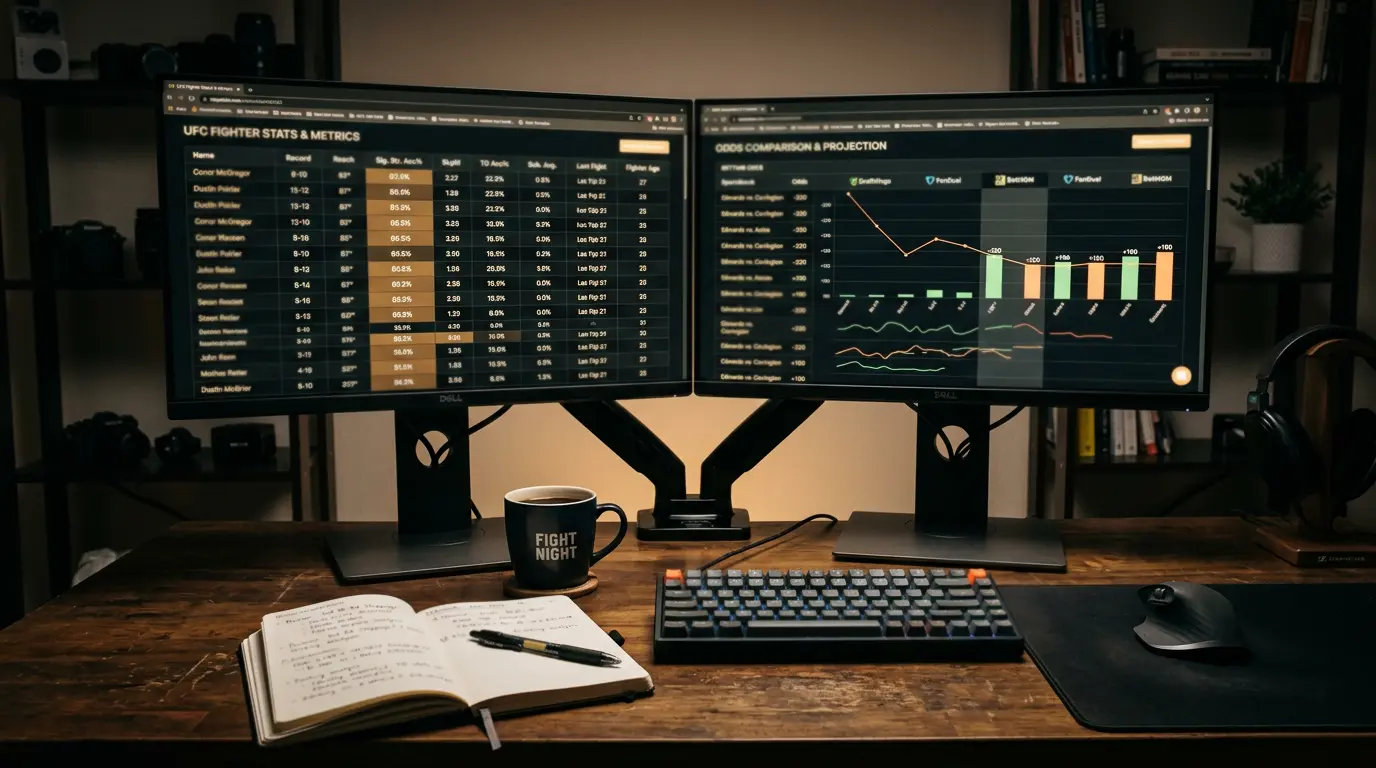
For the first two years of my UFC betting career I handicapped fights using nothing but memory and gut instinct. I remembered that a fighter had good takedown defence because I had watched him stuff a few shots in his last bout. I guessed that the odds had moved because “the public was all over the favourite.” I was essentially bringing a butter knife to a data fight. The moment I started using proper tools – odds comparison sites, fighter stat databases, and line movement trackers – my results changed overnight. Not because the tools are magic, but because they replaced guesswork with measurement.
The MMA betting handle hit $10.3 billion in 2024, growing 17% on the prior year. That kind of volume generates an enormous amount of data, and the punters who capture and use that data have a structural advantage over those who do not. The tools I am about to walk you through range from completely free to modestly priced, and every one of them has earned a permanent place in my pre-fight research routine.
Utilizing UFC Odds Comparison Platforms
Shopping for the best price is the lowest-effort, highest-impact improvement most UFC punters can make. Bet365 – the largest UFC bookmaker in the UK – carries a margin of roughly 4% on major bouts, but that figure varies by fight and by market. A competitor might offer the same fighter at a noticeably better price on the same evening. Over a year of betting, consistently grabbing the best available odds adds up to several percentage points of improved return, which is often the difference between a losing record and a profitable one.
The best odds comparison tools for UFC aggregate prices from multiple bookmakers in real time, letting you see at a glance which platform offers the tightest price on each fighter. Some display the odds in fractional, decimal, and American formats simultaneously, which saves you the conversion step. A few also show historical odds, letting you track how the price has moved from opening to closing – a feature I use heavily for line movement analysis.
My routine is simple: before placing any UFC bet, I check the price across at least four UK bookmakers using a comparison site. The two-minute investment regularly saves me 5-10% on individual wagers. On a three-leg accumulator, the compound effect of grabbing the best price on each leg can be substantial.
Fighter Stat Databases and Analytics
Raw fight results tell you who won. Fighter stat databases tell you how and why. The databases I rely on track metrics that feed directly into my handicapping: significant strikes landed per minute, striking defence percentage, takedown accuracy, takedown defence, submission attempts per fifteen minutes, and control time. These numbers, compared across the specific fighters in a matchup, produce a clearer picture than any amount of highlight-reel watching.
The critical distinction between useful stats and noise is normalisation. A fighter who has landed 450 significant strikes across their UFC career sounds impressive until you realise they have fought fifteen times and averaged 30 per fight, which is below average for their division. Per-minute rates strip out fight count and duration distortion, giving you a metric that is actually comparable across fighters with different career lengths and fight styles.
I pay particular attention to recent-form stats – the last three to five fights rather than career averages. A fighter’s career takedown defence might sit at 72%, but if it has declined to 58% across their last three bouts, the career figure is masking a deterioration that is relevant to the next fight. Stat databases that let you filter by date range or number of recent bouts are significantly more useful than those offering only career totals.
The better analytics platforms also provide divisional benchmarks. Knowing that the average heavyweight lands 3.8 significant strikes per minute lets you contextualise a specific fighter’s 5.2 as notably above average. Without the benchmark, the raw number is almost meaningless.
Line Movement and Historical Odds Trackers
I once watched a UFC co-main event line move from -140 to -210 over four days with no public news to explain the shift. The line movement tracker showed exactly when the move happened – a single sharp spike at 3 AM on a Wednesday – which told me professional money had driven the change. That information did not tell me who to bet, but it told me the market was pricing something I might be missing, and that signal alone was worth the research time.
Historical odds trackers archive the opening and closing lines for every UFC fight, often with timestamped snapshots of intermediate prices. This data lets you study patterns: how much do favourites typically shorten between opening and closing? How often does a reverse line movement (where the line moves against the public betting trend) predict the outcome? These are empirical questions that can only be answered with historical data, and the trackers provide that data for free or at low cost.
The most practical use of historical odds data is calibrating your betting timing. If you can demonstrate from past data that underdogs in a specific odds range typically drift by 10-15% between Monday and Saturday, you know to wait until fight week to place your underdog bets. If favourites consistently shorten by 20% across the same period, you know to bet early when backing the chalk. These patterns are not guaranteed to repeat, but they provide a probabilistic framework that beats guessing.
Free vs Paid: What Is Worth Paying For
Most of the tools I use daily are free. Odds comparison sites, basic fighter stat databases, and line movement trackers all have free tiers that cover the essentials. The free versions typically display current odds, career stats, and basic line history. For most recreational UFC punters, the free tier is more than sufficient.
Where paid tools justify their cost is in three areas. First, advanced filtering and custom queries. A paid stat platform might let you run a query like “show me all welterweight fighters with a takedown defence above 75% who are facing an opponent with a takedown accuracy above 50%” – the kind of specific, matchup-relevant analysis that free tools cannot produce. Second, real-time alerts. Some paid services notify you when a UFC line moves beyond a threshold, which is invaluable if you cannot monitor prices all day. Third, historical data depth. Free trackers might archive the last twelve months of line data; paid services may go back five or ten years, which lets you study long-term patterns with larger sample sizes.
My personal rule: I will pay for a tool if it saves me more than its annual cost in improved odds or prevented losses. A subscription that costs fifty pounds a year but helps me capture even a half-percent improvement across two hundred bets is paying for itself several times over. A subscription that offers flashy dashboards but does not change my actual decision-making is a waste of money regardless of how professional it looks.
One area where I strongly advise against paying: tipster services. The overlap between “tools” and “tips” is where most punters waste money. A tool gives you data and lets you draw your own conclusions. A tipster gives you conclusions and asks you to trust them. In a market as volatile as UFC – where underdogs win 35% of fights and a single punch can invalidate any prediction – the value of tips degrades rapidly, while the value of data is cumulative and permanent.
For a deeper understanding of how to apply the data these tools provide to specific matchup scenarios, the matchup analysis guide walks through the process of converting raw fighter stats into actionable betting decisions.
What is the best free tool for comparing UFC odds?
Several free odds comparison sites aggregate UFC prices from major UK bookmakers in real time. The best ones display fractional, decimal, and American formats simultaneously, show line movement history, and update within minutes of bookmaker price changes. Check multiple comparison sites rather than relying on one, as coverage and update speed vary.
Do professional UFC bettors use paid analytics platforms?
Some do, particularly for advanced filtering, historical data, and real-time line movement alerts. However, the core of professional UFC handicapping – watching fights, analysing matchups, and comparing odds – relies on freely available data. Paid platforms offer efficiency and depth rather than a fundamentally different informational edge. The most common paid tool among serious bettors is a subscription for historical odds data with advanced query capabilities.
Prepared by the ufc Fight Bets editorial staff.