MMA Wagering Terms: UFC Betting Glossary
 Available in US
When I started betting on UFC, I walked into a world of jargon that felt designed to exclude newcomers. “Chalk” this, “vig” that, “steam move” on the “dog”. I spent my first three months nodding along in forums while privately googling every other word. This glossary is the reference I built for myself over the years, expanded into a resource that covers every term a UK punter will encounter when betting on MMA. The MMA betting handle reached $10.3 billion in 2024, and the terminology has grown alongside the market.
Terms are grouped alphabetically. Where a term has both UK and US variants, both are listed.
Essential UFC Betting Terms: Accumulator to Futures
Accumulator (acca) – a single bet combining multiple selections from different fights. All legs must win for the bet to pay out. The US equivalent is “parlay”. The odds multiply across legs, creating a higher potential payout but a lower probability of winning.
Action – a bet that has been accepted and is live. “I have action on the main event” means you have money riding on the fight.
Bankroll – the total amount of money set aside for betting. A dedicated bankroll is separate from personal finances and is the foundation of disciplined staking.
Bet builder – a tool that lets you combine multiple selections from the same fight into a single wager. Also called “same game multi” or “request a bet” on some platforms.
Bout – a single fight. Used interchangeably with “fight” in UFC contexts.
Chalk – slang for the favourite. “The chalk won” means the favoured fighter won. Derived from the era when bookmakers wrote favourites in chalk on boards.
Closing line – the final odds offered before a fight begins. Widely regarded as the most accurate price because it has been shaped by the full weight of market activity.
Decision – a fight outcome determined by judges’ scorecards after going the full scheduled distance. Subdivided into unanimous decision (all three judges agree), split decision (two judges pick one fighter, one picks the other), and majority decision (two judges pick one fighter, one scores it a draw).
Dog – slang for underdog. The fighter expected to lose, reflected by longer (higher-paying) odds.
Edge – the mathematical advantage a bettor has over the bookmaker on a specific wager. If you believe a fighter has a 45% chance of winning but the odds imply only 35%, your edge is approximately 10 percentage points.
Expected value (EV) – the average profit or loss per bet over a large number of repetitions. A positive EV bet is one where the long-run return exceeds the stake.
Favourite – the fighter expected to win, reflected by shorter (lower-paying) odds. In fractional odds, the favourite is the fighter whose numerator is smaller than the denominator (e.g., 1/3).
Fractional odds – the UK-standard odds format. In the UK, betting winnings are tax-free for punters because the operator pays the tax. Expressed as a fraction: 5/2 means you win five pounds for every two pounds staked, plus your original stake back.
Futures – a bet on an outcome that will be determined at a later date, such as “who will be UFC lightweight champion at the end of 2026”. Futures typically carry wider margins than fight-specific bets.
G–M: GamStop to Moneyline
GamStop – the UK’s national online self-exclusion scheme. Registering blocks access to all UKGC-licensed online gambling platforms for a minimum of six months.
Handle – the total amount of money wagered on a market or event. “The handle on the main event was $5 million” means $5 million was bet across all outcomes.
Hedge – placing a bet on the opposite side of an existing wager to guarantee a profit or limit a loss, regardless of outcome.
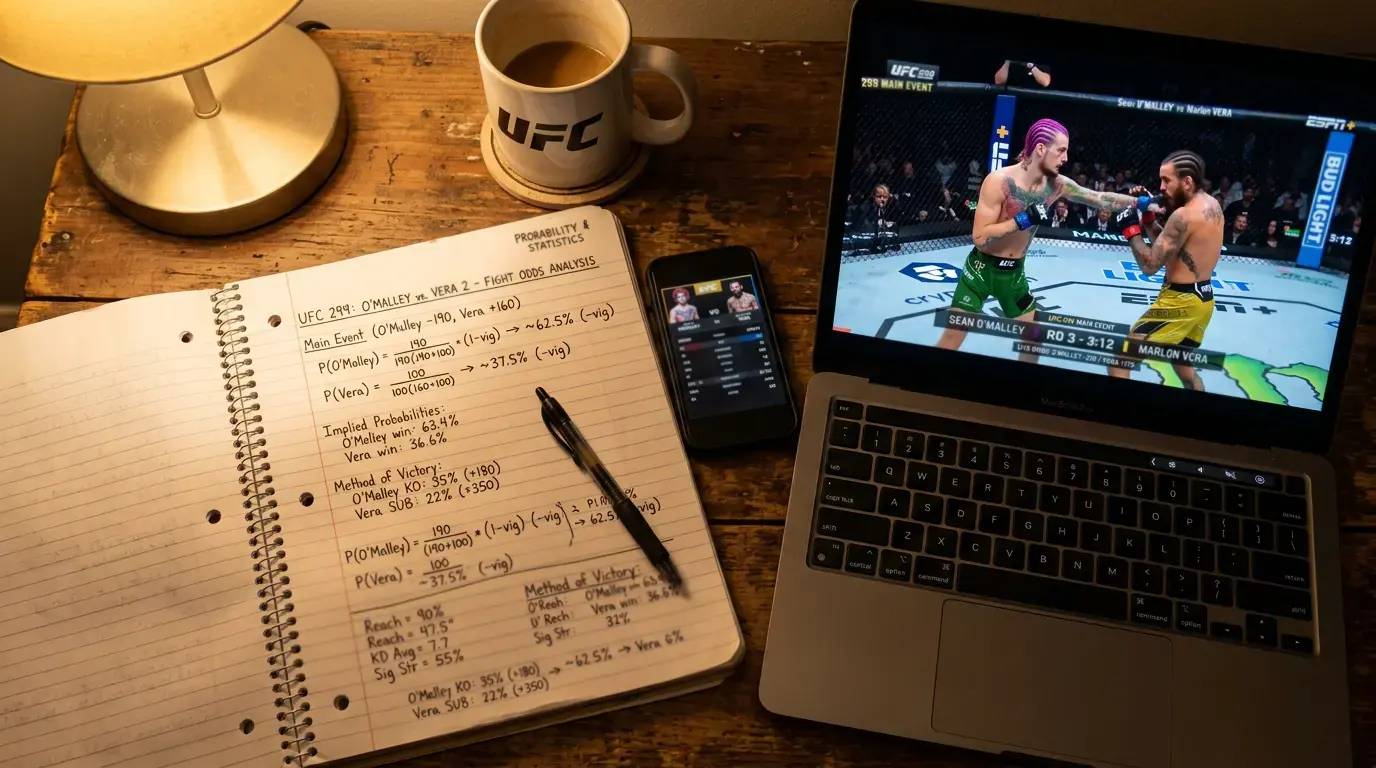
Implied probability – the win percentage embedded in a set of odds. Calculated by converting the odds into a percentage. A fighter at 1/2 fractional has an implied probability of approximately 66.7%.
In-play (live betting) – betting on a fight while it is in progress. Odds adjust in real time based on what is happening in the Octagon. UFC’s round structure creates natural windows for in-play wagering between rounds.
Juice – see “vig”. The bookmaker’s commission built into the odds.
Line – the odds or point spread set by the bookmaker. “The line moved from -150 to -200” means the favourite became more heavily favoured.
Line movement – a change in odds between the opening line and the closing line. Movement can be driven by sharp money, public money, or news.
Lock – a bet perceived as certain to win. In reality, no UFC bet is a lock – underdogs win about 35% of fights.
Moneyline – a bet on which fighter will win the fight, without any point spread or conditions. The simplest and most common UFC bet type.
N–S: No Contest to Submission
No contest (NC) – a fight result where neither fighter is awarded a win, typically due to an accidental foul that prevents the fight from continuing. Moneyline bets are voided on no contest results.
Opening line – the first odds posted by a bookmaker for a fight. Opening lines are less accurate than closing lines because they have not yet been tested by market activity.
Overround (over-round) – the bookmaker’s built-in margin, calculated by summing the implied probabilities of all outcomes in a market. An overround of 105% means the bookmaker has embedded a 5% margin.
Parlay – the US term for accumulator. A single bet combining multiple selections where all must win.
Pick’em – a fight where neither fighter is favoured, with both priced at or near even money. Rare in UFC because matchmaking usually produces a clear favourite.
Prop bet (proposition bet) – any bet beyond the simple fight winner. Includes method of victory, round totals, significant strikes, and fight specials.
Punter – UK term for a person who places bets. The US equivalent is “bettor” or “handicapper” (though handicapper implies a more analytical approach).
Push – a bet that results in neither a win nor a loss, with the stake returned. In UFC, pushes occur when a fight is cancelled or voided.
Reverse line movement – when the line moves in the opposite direction from where the majority of bets are placed. This usually indicates sharp money on the less popular side.
Sharp (sharp bettor) – a professional or highly informed bettor whose wagers are respected by bookmakers and can move lines.
Square – a casual or recreational bettor. The opposite of a sharp.
Steam move – a sudden, dramatic line shift caused by a large volume of sharp money entering the market simultaneously. Multiple bookmakers adjust their odds almost instantly.
Submission – a fight-ending technique where one fighter forces the opponent to “tap out” or renders them unconscious through a choke or joint lock. A common method of victory bet option.
T–Z: Total Rounds to Vig
TKO (technical knockout) – a stoppage by the referee when a fighter is taking unanticipated damage and cannot intelligently defend themselves. Grouped with KO in most betting markets.
Total rounds (over/under) – a bet on whether the fight will last more or fewer rounds than a line set by the bookmaker. A common line is 2.5 rounds for a three-round fight.
Tout – a person who sells betting picks or predictions, often with exaggerated claims of accuracy. Approach with scepticism.
UKGC (UK Gambling Commission) – the regulatory body that licences and oversees all legal gambling operators in the United Kingdom. A UKGC licence is mandatory for any bookmaker accepting bets from UK residents.
Underdog – the fighter expected to lose, carrying longer odds. Underdogs win approximately 35% of UFC fights.
Unit – a standardised bet size relative to your bankroll. If your bankroll is one thousand pounds and your unit is 2%, one unit equals twenty pounds.
Value – a betting opportunity where the odds offered exceed the true probability of the outcome. A fighter with a 50% chance of winning priced at 6/4 (implied probability 40%) represents value.
Vig (vigorish) – the bookmaker’s commission, embedded in the odds. Also called “juice” or “the take”. On a market with an overround of 106%, the vig is 6%.
Void – a cancelled bet where the stake is returned. Fights that are cancelled, result in no contest, or meet other specific conditions may be voided by the bookmaker.
Wager – a bet. Used interchangeably with “bet” and “stake” in casual contexts, though technically the wager is the act and the stake is the amount.
If you are brand new to UFC betting and want a step-by-step walkthrough of placing your first bet, the beginners guide covers the entire process from bookmaker selection to your first fight wager.
What does ‘chalk’ mean in UFC betting?
Chalk is slang for the favourite – the fighter with the shorter odds who is expected to win. The term originates from the era when bookmakers wrote odds on chalkboards, with the most popular selections requiring frequent updates. ‘Eating chalk’ means betting on heavy favourites, often at unattractive odds.
What is the difference between a punter and a handicapper?
A punter is the UK term for anyone who places bets, regardless of their approach or skill level. A handicapper is typically someone who analyses fights systematically to produce predictions, often for a living or as a serious pursuit. All handicappers are punters, but not all punters are handicappers. The US equivalent of punter is bettor.
Published by the ufc Fight Bets team.